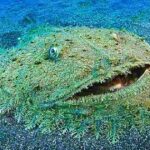
This strange “carpet Shark” is the ocean’s most perfect Ambush Predators
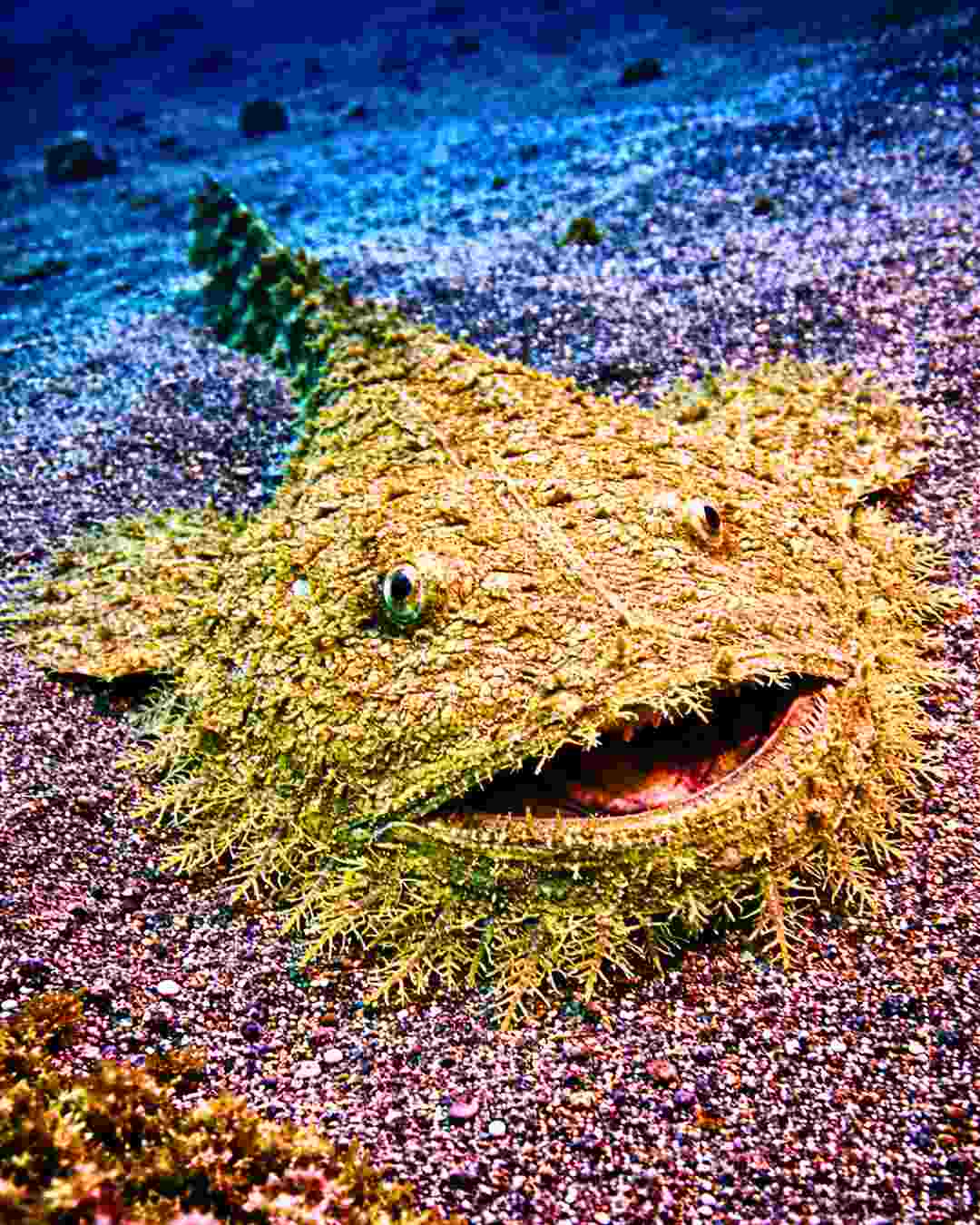
Ever wondered which shark might be the strangest-looking in the ocean? The tasselled wobbegong is a strong contender.
Often grouped under the name carpet sharks, wobbegongs are instantly recognizable by their unusual, flattened bodies and the distinctive fringes of skin that surround their heads. These branched lobes give them a bizarre, almost plant-like appearance—making them look more like part of the reef than a living predator.
Although the tasselled wobbegong was first scientifically described in 1867, it remains one of the ocean’s more mysterious sharks, largely because of its secretive nature and excellent camouflage.

(Update note: some viral images thought to show wobbegongs have later been identified as anglerfish from the Lophiidae family. Either way, it’s still not something you’d want to step on.)
The tasselled wobbegong (Eucrossorhinus dasypogon) belongs to the carpet shark family Orectolobidae and inhabits shallow coral reefs off northern Australia, New Guinea, and nearby islands. It can grow up to 1.8 meters (5.9 feet) long and has a broad, flattened head and body perfectly suited for life on the seafloor.
Its most remarkable feature is the elaborate fringe of branching dermal flaps around its head and chin. These structures break up the shark’s outline, allowing it to blend seamlessly into coral, rocks, and algae—an almost perfect disguise.

During daylight hours, tasselled wobbegongs are typically solitary and inactive. They are often found resting inside caves or beneath rocky ledges, their tails curled close to their bodies. But once night falls, they become far more active, moving out onto the reef to hunt.
While generally not aggressive hunters in the open water, tasselled wobbegongs are capable of biting humans—sometimes without clear provocation. Most recorded incidents are believed to occur when people accidentally disturb a resting shark or when the animal mistakes a limb for prey.
Among carpet sharks, the tasselled wobbegong is considered the most specialized species. Its ornate coloration and complex body shape provide unmatched camouflage, even though it is likely a slower swimmer than many of its relatives.
That slower speed is not a disadvantage. The species relies on ambush predation, remaining motionless until prey comes within striking distance. Individual sharks maintain small home ranges containing several favored resting sites, which they return to repeatedly. At night, they leave these shelters to hunt across the reef.
The tasselled wobbegong’s large mouth allows it to consume surprisingly big prey. In one documented case, a 1.3-meter-long individual was recorded swallowing a 1.0-meter brown-banded bamboo shark—an astonishing feat.
Although most active after dark, the shark also hunts opportunistically during the day. It preys on schooling nocturnal fish such as soldierfish, squirrelfish, and sweepers, which often hide in the same caves where the wobbegong rests.

Even more fascinating is its use of luring behavior. Small fish and crustaceans have been observed gathering around the shark’s head while it rests. These attract larger fish, which are then ambushed. Observations in captivity suggest the wobbegong actively enhances this trap by slowly waving its tail from side to side.
When moved in this way, the tail resembles a small fish, complete with a dark eyespot near its base. Since the shark typically rests with its head slightly raised, any curious prey drawn in by the “bait” ends up dangerously close—sometimes including humans.
Indeed, tasselled wobbegongs have a reputation for being more aggressive than related species when disturbed. In 1940, Australian biologist Gilbert Whitley even claimed the shark “attacks and generally kills the natives” of Papua New Guinea. While the accuracy of that statement is uncertain, there is no doubt the species can inflict serious injuries.
Despite this, the tasselled wobbegong is also a popular subject for ecotourism, and many divers encounter it without incident. Still, due to its cryptic appearance and relatively poor vision, caution is strongly advised. Accidentally touching or stepping on one is one of the most common triggers for bites.
Perfect camouflage comes with real risk—so once again, don’t step on it.
Unfortunately, even in the limited regions where the tasselled wobbegong still exists, its habitat is shrinking. Overfishing, pollution, blast fishing, and coral removal continue to reduce suitable reef environments, placing additional pressure on an already specialized species.
So if you ever find yourself in one of the few places where this shark lives, stay alert. Some creatures are dangerous not because they chase you—but because you never see them at all.